AI Call Center Software AI 콜센터 소프트웨어 is reshaping how businesses handle customer interactions. By combining automation, natural language processing, and real-time analytics, it helps teams deliver faster, more personalized support while reducing operational costs and agent stress. Companies that understand why AI call center solutions are critical for omnichannel customer journeys can optimize every customer touchpoint, while leveraging the benefits of virtual agent assist in modern customer service ensures support teams remain efficient and responsive.
Selecting the right AI call center software requires understanding both the technical backbone and operational benefits. By adopting emerging technologies that improve automated customer service efficiency, businesses can manage large volumes of requests without delays, using intelligent routing and predictive analytics to anticipate customer needs. Similarly, leveraging high-performance computing systems to analyze real-time customer interaction data allows teams to extract actionable insights, detect patterns, and optimize workflows across multiple channels.
Beyond technology, integrating comprehensive online marketing strategies that drive customer engagement through digital campaigns ensures that support services are aligned with brand messaging and promotional efforts. Combining these strategies with advanced digital marketing approaches for increasing lead conversions and improving customer experience helps organizations personalize outreach while maintaining efficiency.
On the financial side, using robust financial planning resources to maximize return on AI-driven call center investments ensures that expenditures on software, infrastructure, and personnel generate measurable outcomes. Proper implementation of AI call center software not only reduces operational costs but also improves agent productivity and strengthens customer satisfaction.
By uniting advanced technology, strategic marketing, and financial intelligence, AI call center software transforms traditional support operations into agile, customer-focused experiences. This holistic approach ensures every interaction is faster, more personalized, and more effective, empowering businesses to meet modern customer expectations consistently.
Top 10 AI Call Center Software Solutions for Modern Contact Centers
Managing customer interactions efficiently requires the right AI call center software. Here’s a list of the top solutions that can help businesses deliver personalized, fast, and reliable support while improving operational efficiency.
1. Bright Pattern – Advanced AI Contact Center Solutions
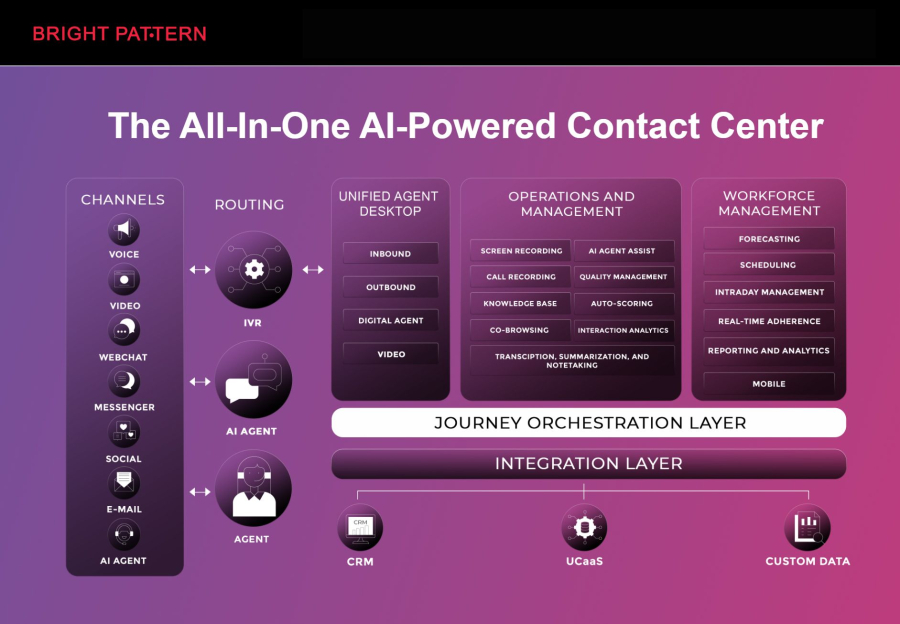
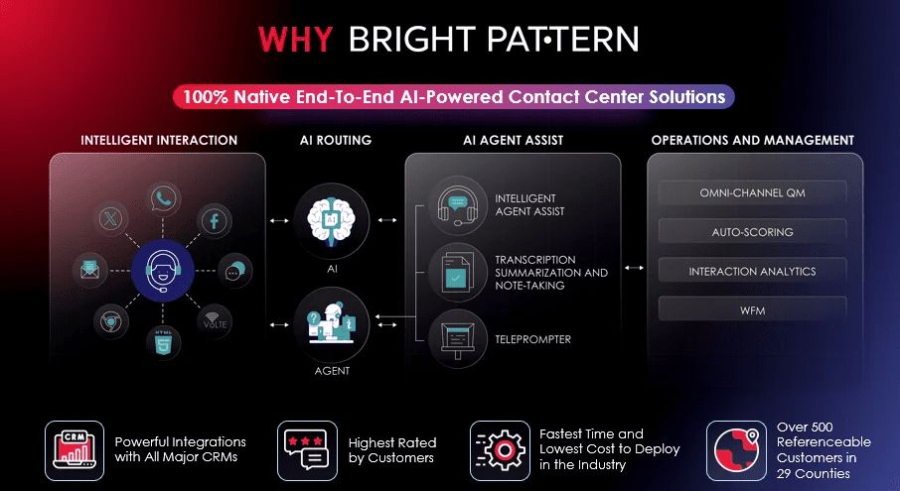
Bright Pattern stands out as a leading AI call center software for organizations looking to optimize every customer interaction. Its platform combines automation, omnichannel routing, and real-time analytics to improve both agent productivity and customer satisfaction.
Key features include:
- Omnichannel customer engagement across voice, chat, email, and social media
- Virtual agent assist to reduce agent workload and speed up resolutions
- Predictive analytics and reporting for better decision-making
- Seamless integration with CRM, marketing, and support systems
- Scalability to meet the needs of growing enterprises
With Bright Pattern, businesses can implement AI contact center solutions that streamline workflows, enhance agent performance, and provide a more personalized experience for every customer.
2. Genesys Cloud CX
Genesys Cloud CX offers AI-driven routing, workforce optimization, and real-time analytics to deliver superior customer service. Its platform supports multichannel communication and empowers agents with AI-assisted tools.
3. Five9 Intelligent Cloud Contact Center
Five9 provides AI-powered automation for call routing, virtual agents, and predictive dialers. The software focuses on reducing call wait times and improving customer satisfaction.
4. NICE inContact CXone
NICE inContact CXone combines AI analytics, omnichannel routing, and workforce management to optimize contact center operations and enhance the customer experience.
5. Talkdesk CX Cloud
Talkdesk CX Cloud delivers AI call center software with virtual agents, workflow automation, and detailed reporting. It helps teams provide faster, more accurate support.
6. RingCentral Contact Center
RingCentral integrates AI-driven tools for routing, analytics, and workforce management. It provides a unified platform to manage voice, chat, and email interactions efficiently.
7. 8x8 Contact Center
8x8 uses AI for real-time speech analytics, routing, and virtual agent support. Its platform helps contact centers reduce operational costs while improving service quality.
8. Avaya OneCloud CCaaS
Avaya OneCloud CCaaS delivers AI-powered engagement across channels, with predictive routing and analytics to optimize agent efficiency and customer satisfaction. Its platform supports both human and virtual agents, enabling smooth handling of high-volume interactions.
9. Salesforce Service Cloud Voice
Salesforce Service Cloud Voice integrates AI call center features directly into the CRM, offering real-time transcription, sentiment analysis, and automation for faster resolutions.
10. Amazon Connect
Amazon Connect provides cloud-based AI call center software with intelligent routing, virtual agents, and real-time analytics to improve customer experiences at scale. Its flexible platform allows businesses to easily scale and customize workflows for all types of customer interactions.
What Is AI Call Center Software?
AI call center softwareis a set of tools that uses artificial intelligence to manage, automate, and enhance customer interactions in a contact center. It can assist or fully handle tasks such as answering routine questions, routing calls to the right agents, analyzing sentiment, and providing agents with real-time recommendations.
Unlike traditional call center systems that rely heavily on manual processes and rule-based routing, AI solutions learn from every interaction, get smarter over time, and adapt to changing customer needs.
Key Benefits of AI Call Center Software
When deployed effectively, AI call center software delivers meaningful gains across customer experience, operations, and employee engagement.
- Faster response timesthanks to intelligent call routing, automated assistance, and self-service options.
- 24/7 availabilityso customers can get help anytime, even outside standard business hours.
- Higher first contact resolutionas AI matches customers with the best resources and surfaces the right information instantly.
- Reduced operational costsby automating repetitive tasks and handling high volumes without scaling headcount at the same rate.
- Better customer satisfactionthrough personalized experiences, shorter queues, and more accurate answers.
- Improved agent productivitywith real-time guidance, suggested responses, and automated after-call work.
- Deeper insightsvia analytics that mine every interaction for trends, pain points, and opportunities to improve.
- Scalable operationsthat can handle spikes in demand without sacrificing experience quality.
How AI Call Center Software Works
AI call center software typically includes several integrated components that work together to improve both self-service and live-agent interactions.
Core Components
- Natural language processing (NLP)interprets what customers say or type, even when phrased in different ways, and maps it to the right intent.
- Intelligent virtual agents (IVAs)or bots handle common inquiries, guide customers through workflows, and escalate calls when needed.
- Automatic call distribution (ACD) with AI routinguses data such as customer history, intent, and agent skill set to route calls to the best available resource.
- Speech recognition and text-to-speechallow spoken conversations between customers and automated systems.
- Real-time analyticsmonitor call volume, wait times, sentiment, and agent performance as conversations happen.
- Agent assist toolsprovide recommended answers, prompts, and resources to agents during live calls or chats.
- Quality and compliance monitoringuses AI to review interactions for adherence to scripts, policies, and regulatory requirements.
High-Level Workflow
- Customer reaches out.The interaction may start via phone, chat, email, messaging app, or web form.
- AI identifies intent.NLP analyzes the customer’s words, detects intent, and may classify the request (for example, billing, technical support, or account changes).
- Self-service or routing.If the query is straightforward, an AI assistant can answer directly. If it is complex or sensitive, AI routes the customer to the right agent, including passing along context.
- Agent assistance kicks in.During live calls or chats, the AI suggests responses, knowledge base articles, or next steps to the agent.
- After-call processes.AI can summarize the conversation, categorize it, and update CRM or ticketing records, saving agents time.
- Continuous learning.The system uses feedback, outcomes, and new data to improve its models and recommendations over time.
Top Use Cases for AI Call Center Software
AI is versatile, but some scenarios generate particularly strong returns when automated or augmented.
1. Intelligent Self-Service and Virtual Agents
AI-powered virtual agents can handle a significant portion of routine inquiries without human intervention, such as:
- Checking account balances or order status.
- Resetting passwords or updating contact details.
- Scheduling, confirming, or changing appointments.
- Providing basic troubleshooting steps for common issues.
When designed well, these experiences feel conversational and helpful, freeing human agents to focus on higher-value, complex, or emotionally sensitive interactions.
2. Smart Call Routing and Prioritization
Instead of simple round-robin or skills-based routing, AI can consider a broader set of signals to decide how to handle each call, including:
- Customer history and previous interactions.
- Estimated intent based on IVR responses or pre-call data.
- Agent performance trends and current workload.
- Priority levels, such as high-value customers or urgent cases.
This leads to higher first contact resolution, reduced transfers, and a more efficient use of your team’s capabilities.
3. Real-Time Agent Assist
On live calls or chats, AI can act as a silent partner to the agent, offering support like:
- Suggested replies or next best actions based on the conversation.
- Instant access to relevant knowledge base articles.
- Prompts to capture key information for compliance or quality.
- Reminders when the customer expresses dissatisfaction or intent to leave.
This support reduces the cognitive load on agents, shortens handle times, and helps new hires ramp up faster.
4. Sentiment Analysis and Experience Management
AI can detect emotional cues in voice and text, such as frustration, confusion, or satisfaction. This enables call centers to:
- Alert supervisors to at-risk conversations in real time.
- Identify patterns behind low satisfaction scores.
- Understand which scripts or approaches resonate best with customers.
- Tailor coaching and training to actual customer feedback.
5. Automated Quality Assurance and Compliance
Instead of manually reviewing a small sample of calls, AI can scan a much larger portion of interactions, helping teams:
- Check for required disclosures or statements on every call.
- Identify process gaps that cause long handle times or repeat contacts.
- Spot non-compliant language or missed steps early.
- Generate objective quality insights for coaching and recognition.
6. Forecasting and Workforce Optimization
By analyzing historical volumes, patterns, and external factors, AI can help forecast demand and optimize schedules. This supports:
- Better staffing decisions and reduced overtime.
- Shorter wait times during peak periods.
- Balanced workloads across teams and channels.
Key Features to Look For in AI Call Center Software
When evaluating solutions, focus on capabilities that directly support your goals and use cases.
AI and Automation Features
- Conversational IVR and virtual agentsthat can understand natural language and handle end-to-end workflows.
- Omnichannel supportfor voice, chat, email, and messaging, with consistent experiences across channels.
- Agent assisttools that provide real-time recommendations, scripts, and knowledge suggestions.
- AI-powered routingbased on skills, intent, sentiment, and customer data.
- Automatic summaries and note-takingto speed up wrap-up work.
Analytics and Reporting
- Real-time dashboardsfor wait times, handle times, backlog, and service levels.
- Interaction analyticsincluding transcripts, sentiment, and topic analysis.
- Quality monitoringwith automatic scoring and alerts.
- Custom reportingthat reflects your unique KPIs and workflows.
Integration and Data Management
- CRM and ticketing integrationsso data flows seamlessly between systems.
- Knowledge base connectionsthat allow AI to draw from existing documentation.
- Open APIsfor extending functionality or connecting to internal tools.
- Robust data controlsfor permissions, retention, and privacy.
Security, Privacy, and Governance
- Data encryptionin transit and at rest.
- Access controlsand audit logs for sensitive information.
- Configurable data retentionin line with your policies and regulations.
- Transparent AI behaviorwith options to review training data sources and logic where applicable.
How to Choose the Right AI Call Center Software
Finding the best solution means aligning technology capabilities with your business objectives, customer expectations, and operational reality.
1. Start With Clear Goals
Define what success looks like before you compare platforms. Common goals include:
- Reducing average handle time or queue time.
- Improving first contact resolution.
- Increasing self-service containment for routine inquiries.
- Enhancing customer satisfaction or loyalty scores.
- Supporting growth without a proportional increase in headcount.
Having concrete goals helps you prioritize features and measure impact after deployment.
2. Map Your Customer Journeys
Look at the real paths customers take when they seek help. Identify:
- The most common questions or tasks.
- Points of friction or repeated handoffs.
- Moments where emotional sensitivity is high and human empathy is essential.
This analysis will show where AI should automate, where it should assist agents, and where human-led interactions must remain central.
3. Evaluate Ease of Use
A powerful system is only valuable if your team can use it confidently. Consider:
- How intuitive the interface is for supervisors and agents.
- Whether non-technical users can configure flows, prompts, and routing.
- The quality of onboarding materials, documentation, and support.
4. Check Integration Capabilities
AI is most effective when it can access context and data from your existing tools. Confirm that the solution:
- Connects reliably to your CRM, help desk, and communication channels.
- Can ingest historical data and past interactions where helpful.
- Supports your current and planned technology stack.
5. Consider Scalability and Flexibility
Choose a platform that can grow with you, accommodating:
- Rising interaction volumes and new channels.
- Additional languages, regions, or business units.
- Evolving workflows as your products and services change.
Implementation Best Practices
Successful AI call center deployments are typically phased, collaborative, and focused on measurable results.
Phase 1: Plan and Prioritize
- Engage stakeholdersfrom operations, IT, customer experience, and compliance early.
- Select initial use casesthat are high volume, well defined, and low risk.
- Define metricsfor success such as containment rate, handle time, or satisfaction scores.
Phase 2: Design Customer-Centric Flows
- Use plain, friendly languagefor prompts and bot conversations.
- Always offer an easy pathto reach a human when needed.
- Test flowsinternally and with small customer groups before broad rollout.
Phase 3: Train and Support Agents
- Explain how AI worksand how it supports, rather than replaces, agents.
- Offer hands-on trainingon using agent assist, reading suggestions, and giving feedback.
- Recognize quick winssuch as reduced after-call work or easier access to information.
Phase 4: Measure, Learn, and Iterate
- Review analyticsfrequently in the early stages to catch friction points.
- Gather qualitative feedbackfrom agents and customers.
- Refine prompts, flows, and routingbased on real-world performance.
AI Call Center Software and the Human Element
AI is most powerful when it augments people rather than attempting to replace them. High performing call centers use AI to free agents from repetitive tasks so they can focus on what humans do best:
- Building trust and empathy with customers.
- Handling complex, multi-step issues.
- Making nuanced judgments when policies and real-world situations collide.
- Spotting opportunities for upsell, cross-sell, or deeper engagement.
By positioning AI as a supportive teammate, organizations often see higher adoption, stronger morale, and more consistent service quality.
Measuring Success: Metrics to Track
To understand the impact of AI call center software, combine efficiency metrics with customer and employee experience indicators.
Operational Metrics
- Average handle time.
- Average speed of answer and queue times.
- First contact resolution rate.
- Self-service or containment rate for virtual agents.
- Call transfers and escalations.
Customer Experience Metrics
- Customer satisfaction or post-interaction survey scores.
- Sentiment trends across interactions.
- Repeat contact rates for the same issue.
Agent Experience Metrics
- Handle time distribution between complex and simple tasks.
- Time spent on after-call work.
- Agent turnover and engagement indicators.
Future Trends in AI Call Center Software
The capabilities of AI-powered contact centers continue to expand. Some emerging trends include:
- More natural conversationsdriven by advances in large language models and voice technologies.
- Proactive outreachwhere AI anticipates customer needs and offers help before issues escalate.
- Deeper personalizationusing a richer blend of behavioral, historical, and contextual data.
- Unified analyticsthat combine contact center data with broader customer journey insights.
Organizations that invest early and build internal expertise will be well positioned to take advantage of these developments.
Conclusion: Turning Your Call Center Into a Strategic Advantage
AI call center software gives organizations a powerful toolkit to deliver faster, smarter, and more human customer experiences at scale. By automating routine work, guiding agents in real time, and surfacing deep insights from every interaction, AI transforms the call center from a cost center into a strategic engine for loyalty and growth.
With clear goals, thoughtful design, and an emphasis on collaboration between people and technology, your call center can become a source of competitive advantage and a standout part of your brand experience.
